Why Are We Forced to Smurf? How Deadlock’s “Smart” Matchmaking Breeds the Problem It Claims to Solve

dzahaines

Member
TL;DR: Deadlock's matchmaking actively produces the smurfing it claims to fight. Rank freezes at Initiate 2 are documented and reproducible. Hero pool changes penalize honest players the same way account rentals do. The MVP system rewards personal stats over winning. New accounts outrank mains with ten times the playtime.
I have been playing Valve games since childhood. Ten years across the Counter-Strike series from CS:S to CS2, five years in Dota 2. When I moved to Deadlock, I was hoping to see Valve apply the lessons of over a decade. They have not. The planned matchmaking system carries the same structural problems from both games, now combined and amplified. Multiplayer Valve titles have suffered from three interconnected issues for 14 years: smurf accounts, account boosting, and account rentals. Rather than solving these before Deadlock’s launch, Valve layered a “performance-based” system on top of the same broken foundation; and whether by design or by negligence, the outcome is entirely predictable: poor match quality, rank volatility that shrinks with account age, a saturated black market for smurf accounts, systemically manufactured demand for those very accounts, and third-party service advertisements embedded in leaderboard nicknames.

What does a working matchmaking system look like?

Look up where donk, s1mple, and m0NESY play today. Under a binary Elo system, the only path to success is winning more than you lose against players of your own rating, over hundreds of matches.
Keep that in mind as we examine what Valve is actually building.

Dota 2: Thirteen Years of Uncontrolled Precedent

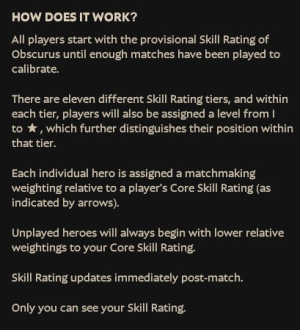
Dota 2 is the most thoroughly documented case of what happens when a matchmaking system cannot close its own exploits. A shadow economy has formed around it with significant turnover. At high MMR, account rentals are so normalized that players in the top 1,000 know every rental account by name and leave lobbies at the hero draft stage when they spot one. Valve is fully aware of this and has done nothing about it in Dota 2. Their proposed solution in Deadlock is binding a hero pool to each account so the system detects when an account changes hands, penalizes honest players: anyone testing a new hero sees their rank drop immediately, which pushes them into lower lobbies and makes creating a smurf the rational choice. The mechanism meant to deter account sharing actively incentivizes it.
1777903491072.png
*Obscurus is Valve's name for the rank below the bottom of the ladder

Support players are the primary victims of any performance-based system. Their contribution cannot be captured in raw numbers; their role exists to enable others. This creates pressure to purchase boosted accounts, since climbing independently requires playing as a semi-carry rather than as a support. In Deadlock, where the system rewards individual statistics, this problem will be felt in its worst possible form. A player documented on the forum, a support main who deliberately keeps a low souls-per-minute to stay active across the map, lost rank after wins precisely because the algorithm read his numbers as underperformance.

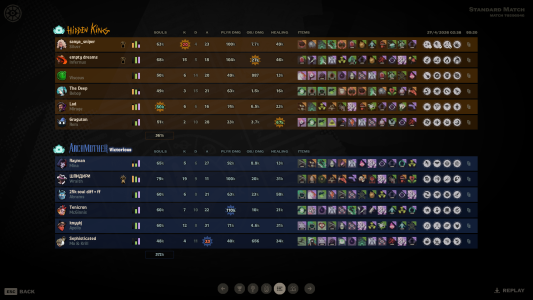
The MVP system makes this structurally worse. The performance layer does not evaluate whether you won - it evaluates whether you individually maximized the right numbers on the right hero. This creates a perverse incentive: playing to win and playing to rank up are not the same objective. The system has been observed distributing post-game awards in ways that confirm this: a team that spent most of the match losing but secured a final teamfight victory can receive one MVP designation, while two players from the losing team are judged to have produced better individual statistics and receive key-player recognition.
one_mvp_match.png
*Match 78596946 pulled from the top of the EU leaderboard documents exactly this outcome

Valve appears to have introduced this asymmetry as an attempted fix for a real problem: you play well, your teammates feed, you lose, and the system punishes you for it. Their solution was to decouple individual recognition from match outcome by awarding key-player status based on personal statistics regardless of which team won. The intention is understandable. The execution is not.

The problem is that some losses cannot be prevented by individual play, no matter how well you perform. If an enemy carry goes 20/0 and has outfarmed your entire team for twenty minutes, the game is structurally over. No amount of personal skill on your part changes the math of a fed hero with a massive net worth advantage walking through your base. You cannot stat-sheet your way out of a structural deficit, and this is because the system has no way to distinguish between a loss caused by your underperformance and a loss caused by a situation that was already decided before you could do anything about it.

So the patch addresses the symptom which is a good player losing rank they didn't deserve to lose without addressing the cause, which is that feeders and smurfs create unwinnable games in the first place. And in doing so, it introduces a new problem: the correct way to play for rank is no longer the same as the correct way to play to win. A player who sacrifices their own statistics to enable a teammate by dying to buy time, rotating instead of farming, or playing the support role in a critical moment, will find the algorithm reading those decisions as underperformance, even if they directly contributed to a victory. The player who farms safely and posts clean numbers while their team loses will sometimes be rewarded more than the player who tried to win and came up short. Rank and victory have become two different objectives, and the system has quietly chosen which one it actually measures.

Counter-Strike 2: The Precedent Already Set

CS2’s Casual map selection allows a Global Elite player to enter an uncalibrated Office lobby and dismantle beginners without any consequence to their rank. Deadlock’s Hero MMR system creates an equivalent mechanic: a player learning a new hero de facto lowers their rank and enters lobbies below their real skill level.

The HvH (hacker-versus-hacker) pool, a segregated lobby for detected cheaters, reveals Valve’s priorities clearly. Instead of banning cheaters, the system isolates them to preserve active-player metrics. Given that Deadlock is partly a shooter, an equivalent solution there is more than likely.

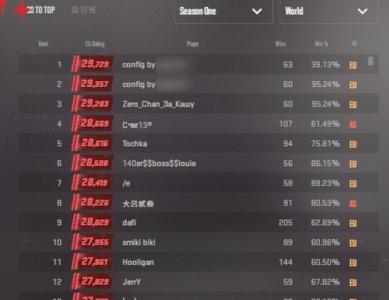
CS2 leaderboards contain accounts with third-party service advertisements embedded directly in their nicknames, which are visible evidence that reaching top rank through cheating and boosting is operationally easier than getting banned.
1777901036991.png

Under a performance-based system in Deadlock, the entry threshold for the leaderboard is even lower, which means this advertising will appear even faster.

Prime matchmaking completes the picture. Valve monetized a problem they created. Fair matchmaking became a paid feature rather than a baseline condition. The precedent exists, and there is no reason to believe Deadlock will not follow the same model.

Deadlock: All of the Above, Simultaneously

Every problem described above is present in Deadlock at once, and the matchmaking system actively amplifies them.

Hero MMR working against honest players. A player ranked in the top 70 of the European leaderboard lost more than 200 positions after several wins. The only change: shifting his primary hero from Dynamo to Paige. Deadlock's Hero MMR is not a hidden inference because it is a visible in-game system, displayed directly in the UI as downward indicators on heroes outside a player's established pool, and documented to place those heroes into easier lobbies. What remains opaque is how far the system extends: the forum case above suggests that a sustained shift in hero pool composition affects not just lobby difficulty on that specific hero, but overall leaderboard position that affects even when the account's win balance is positive. An honest player rotating his main is penalized through the same mechanism as an account changing hands.

Rank freezing is documented and systemic. Forum records show players with 150+ hours and a positive win rate whose rank does not move up or down; it is literally frozen at Initiate 2. Their friends with half the games played and a negative win rate freely climb to Ritualist and Arcanist. One forum user described creating a new account to test the theory: he reached Ascendant 4 in roughly 100 games, while his main account remained frozen at Initiate 2 across hundreds of matches.

The result is reproducible. Another user’s first account holds 600 matches and barely crosses 50% win rate after hundreds of hero experiments. His new account reached Emissary 3 in 16 games, 12 of which were wins. This is not an outlier; it is a pattern reproduced independently by multiple forum users.

The conclusion is already underway. Players are not complaining about smurfing as a moral choice; they describe it as the only rational exit from a system that punishes loyalty to a main account.
The system does not merely fail to fight smurfing. It produces smurfing.

The Initiate Paradox: Empty and Overcrowded at Once
1777901714151.png

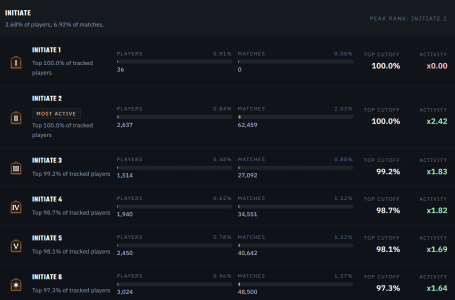
Rank distribution data confirms this statistically. According to deadlocklab.com (last 30 days, 314,937 tracked players), Initiate accounts for just 3.68% of active players - despite being the starting rank for every new account. For context, the Faceit CS2 EU ladder (5,178,584 players, faceitanalyser.com) is the closest available reference point for a matchmaking system that functions predictably: Level 1 holds 2.56% of players, rising steadily to a peak at Level 4 (26.04%), then tapering off toward Level 10 (6.58%). Faceit is not a perfect parallel - it requires identity verification when smurf activity is suspected, and its player base skews toward competitive-minded users rather than the general population. But those same properties make its distribution more meaningful, not less: the bell curve holds even without casual players to inflate the lower ranks, which means the shape reflects genuine skill spread rather than an artifact of player demographics. Low ranks are organically populated because new players arrive, calibrate gradually, and the system does not eject them. Crucially, the system is predictable: a win moves you up, a loss moves you down, and the relationship between performance and rank position is legible to the player. In Deadlock, the bottom of the ladder is statistically near-empty for three simultaneous reasons: smurf accounts sprint through Initiate in 10–20 matches and vanish from the statistics; newcomers either drop the game or get stuck; and those who do get stuck generate a disproportionate number of matches (6.92% of all ranked matches at just 3.68% of players, per the same data).

The most telling figure: Initiate 2 is flagged by deadlocklab.com as the highest-grind subrank on the entire ladder, with an activity index of x2.42, implying that players there generate matches at more than twice the site-wide average pace. That subrank maps precisely onto the forum reports of players frozen at exactly that level.

Sources: deadlocklab.com/ranks (last 30 days, updated May 3, 2026) | faceitanalyser.com/rank-distribution/cs2/EU/

This is why Initiate is statistically empty and simultaneously full of complaints. It is not a contradiction, but two different phenomena of the same system. Most accounts sprint through Initiate in 20 matches via fast calibration and are statistically invisible. Those who get stuck are stuck permanently, because the algorithm is already confident in their assessed level and stops moving their rating. There is no middle ground.

Players frozen at Initiate face a compounding problem beyond the rank ceiling itself. Because the rank is used as a calibration floor, their lobbies are disproportionately filled with two types of opponents: fresh smurf accounts completing calibration, and deliberate feeders who are players who intentionally throw games, knowing they can register a new account at any moment if their loss streak goes too far. For an honest player trying to climb, this means winning a fair match is structurally improbable: the smurfs on the opposing team outclass the lobby by design, and the feeders on their own team actively work against them.
The system places its most vulnerable honest players into its most adversarial environment.

This creates a structural trap for any honest player who learns on their main account. Learning inevitably means losses in the early stages - each of which is cemented into the rating as the system builds confidence in the player’s level. By the time skill has genuinely improved, the algorithm has already classified the account with hundreds of matches as evidence. Escaping without an improbably long unbeaten streak is mathematically close to impossible.

A new account solves this instantly. The same skills, maximum volatility, fast upward calibration in 20 games. The system has not become fairer; only the account changed. Deadlock does not merely tolerate smurfing as a workaround. It makes smurfing the only rational answer to its own mechanics for any player who dared to learn the game honestly.

The Fix Does Not Require a New Algorithm

1. Binary Elo, one queue, no black box.

Win: plus. Loss: minus. No individual statistics, no Hero MMR, no hidden performance layer. The support player who gave their life to enable a teammate objective gets the same plus as the carry with a triple kill - and crucially, can take risks without fearing the algorithm will mark them as a liability based on damage and farm numbers.

2. Elo substantially raises the cost of boosting and that is the key distinction.

In Dota 2 under the current system, a booster running a handful of cheese heroes can lift an account to 8,000–9,000 MMR in a reasonable timeframe and sell it for around €100 at low cost of production is a high-volume market with strong margins. Under Elo, a booster must consistently win across hundreds of matches. The system does not eliminate the market, but it makes production expensive, which naturally limits supply and the scale of the problem. Under Deadlock’s performance-based system, the cost of boosting falls even lower than in Dota 2: it is enough to show the right numbers on the right hero across 20 matches. The smurf account market gains its lowest barrier to entry yet across all three Valve titles.

3. Limit MMR spread within a party instead of penalizing individual performance.

The one genuine problem that a performance-based layer addresses is boosting within a premade group, since individual performance is harder to inflate when playing alongside a booster. The identical problem can be solved with a simple MMR spread restriction within parties; without any of the side effects described in this post.

4. New accounts should start at median MMR with symmetric volatility; not at the floor with downward-sticky volatility.

The current design assigns new accounts the minimum possible MMR and then applies high volatility for the first matches, creating a period where losses are catastrophically sticky. The floor placement is the root cause of the Initiate environment being uniquely hostile: smurf accounts calibrating downward and deliberate feeders both concentrate at the bottom of the ladder, and the system deposits every new player directly into that environment. The correct approach is the inverse: start every new account at median MMR with a moderate volatility window of roughly 20 matches, then let the rating settle naturally from a position that reflects the realistic skill distribution of someone new to ranked play. A newcomer who genuinely belongs at Initiate will calibrate there within 20 games, but they will do so from above, passing through a fair skill band on the way down rather than being trapped in the most adversarial lobby in the game from match one. This single change would eliminate the structural smurf advantage at calibration, reduce the concentration of feeders at the floor, and give honest learners a recovery path without requiring a new account.

5. Volatility must remain meaningful regardless of account age.

This is the only way to give an honest player a path out of a rank acquired during their learning period. If the system needs to be rebuilt incrementally, the minimum viable first step is decoupling Hero MMR from rank volatility, and stopping the reduction of that volatility after N matches.


Valve has already seen this system in action. It is the one the best players in the world use in CS2 on a third-party platform instead of the official ranked mode. That is not coincidence and not advertising. These are players who earn their living from this game and they have collectively chosen to do so somewhere else.
 
Last edited:
BONUS GUIDE: How to Actually Rank Up in Deadlock (As the System Currently Works)


A practical companion to the post above


Step 1: Accept what the system actually measures.

The system does not measure whether you won. It measures whether you looked good doing it. Internalize this before queuing. Your objective is not victory; it is a favorable statistical footprint at the end of the match screen.

Step 2: One hero. Only one.

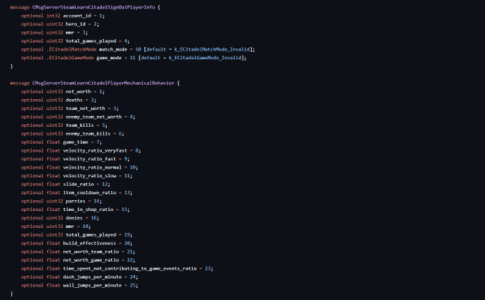
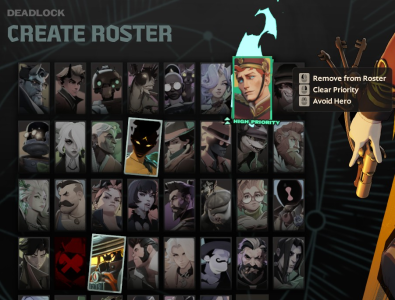
Deadlock's Hero MMR system assigns a separate matchmaking weighting to every hero in the roster. Unplayed heroes always start with a lower weighting relative to your Core Skill Rating; meaning every time you switch, you are effectively entering a softer lobby on that hero while simultaneously signaling to the system that your pool has shifted. Pick one hero, learn it to the ceiling, and do not deviate. The goal is a single Hero MMR that accurately reflects your real skill level, not five half-built ones that collectively drag your Core Skill Rating in unpredictable directions. Variety is for smurfs. On the main, hero diversity is a tax you pay in rating points.

1777916746214.png
*Something like this; one hero at maximum priority, and two backups with no priority at all, to satisfy the minimum three-hero requirement. For the backup slots, pick the current meta's most broken heroes because if you are forced off your main, you want the odds stacked in your favor

Step 3: Prioritize your numbers. In this order.

  • Player damage and objective damage first. These are the most legible metrics to the algorithm. Hit the objective. Hit the enemy. Be visible on the stat sheet.
  • Kills over assists where possible. Assists count, but a kill is unambiguous. If a kill is available, take it. Your support instincts are working against you here, just suppress them.
  • Assists over nothing. If you cannot get the kill, be in the fight long enough to get the assist. Do not rotate away from a fight that is already won.
  • Deaths last. A low death count with mediocre damage will outperform a high-engagement game where you died four times trying to make plays.

Step 4: Know when the game is already lost; and act accordingly.

If your draft is losing, your teammates are feeding, and the enemy carry is 10/0 at fifteen minutes: stop. Do not join teamfights you cannot win. Go to the jungle. Farm. Build your net worth. Your goal at this point is not to claw back an unwinnable game; it is to ensure your personal stat line does not get buried under the avalanche of your team's scoreline. A clean 2/1/6 with high damage in a loss will be read very differently than a 1/5/3 where you died trying to save a teammate who was already dead.

The system cannot tell the difference between "this player farmed jungle because the game was over" and "this player made smart macro decisions". It just sees the numbers. Give it good numbers.

Step 5: Solo queue is a coin flip. Stop flipping coins.

Solo queue in Deadlock means trusting five strangers selected by a matchmaker that has already demonstrated it will place smurfs, feeders, and calibrating accounts in the same lobby without distinction. Do not do this on your main account if you can avoid it. Party queue as often as possible; not because parties play more carefully, but because a coordinated group of people who actually want to win reduces the single biggest variable in whether your game is winnable before it starts: your own teammates. You cannot control the enemy team. You can control who is on yours. A six-stack with a plan will outperform six solo players with better individual skill almost every time, and more importantly, it removes the scenario where your game is decided in the first three minutes by someone on your team who has already decided they are not trying.

Step 6: Don't end the game if you don't have to.

If your team has the enemy base cracked open and the throne is available --- hold. Keep the enemy contained on their base, farm kills and assists as a full team, and let the net worth gap grow. The match outcome is already decided; what is not decided yet is how clean your stat line looks at the end of it. A coordinated team stalling a won game for five extra minutes of kills and player damage is not griefing. It is playing the system at its own game.


P.S. None of the above is how a matchmaking system should work. This guide exists only because the system as it stands rewards these behaviors and pretending otherwise helps no one.
 
Last edited:
Incredible, I hope your explanation works when it's dumbed down by ChatGPT, the guy who does the matchmaking is a vibe coder.
Actually, this opinion about Valve's vibe coders is extremely common in the Dota 2 community, which I'm still part of. Especially after the recent major patch where around 8 heroes were completely broken within the first 24 hours, because of no basic in-game testing before shipping
 
Actually, this opinion about Valve's vibe coders is extremely common in the Dota 2 community, which I'm still part of. Especially after the recent major patch where around 8 heroes were completely broken within the first 24 hours, because of no basic in-game testing before shipping
No I mean literally, he has a twitter, he posts about his vibe coding adventures and he tells us exactly which games he is working on, and he is the Deadlock guy, with some CS2. Yesterday he told us he was quite upset that other game devs think vibe coding is bad, because he finds it very useful.
 
wow

that's fucked.

I felt like there was a serious issue with Deadlock's matchmaking the second I realized that the rank system doesn't properly align to a bell curve. For there to be so many players in Eternus and Initiate, and only around double in the middle ranks, with the highest population seeming to be Oracle, something horribly wrong must be going on.

The answer, is that instead of taking into merely wins and losses, it takes mostly into account "performance"

So you can really get to Eternus by just maxing your stats. You don't need to play to win. And thus getting to the fringes is flat out absurdly easy.

In reality, a much bigger bell curve should be shown, centralized around a middle rank, that properly reflects skill disparity built up over wins and losses. The lack of transparency into what you get from a win or loss is horrible too, it disguises the broken system and I am glad I read this.

Also explains why I'm struggling to get anywhere by playing support.
 
TL;DR: Deadlock's matchmaking actively produces the smurfing it claims to fight. Rank freezes at Initiate 2 are documented and reproducible. Hero pool changes penalize honest players the same way account rentals do. The MVP system rewards personal stats over winning. New accounts outrank mains with ten times the playtime.
I have been playing Valve games since childhood. Ten years across the Counter-Strike series from CS:S to CS2, five years in Dota 2. When I moved to Deadlock, I was hoping to see Valve apply the lessons of over a decade. They have not. The planned matchmaking system carries the same structural problems from both games, now combined and amplified. Multiplayer Valve titles have suffered from three interconnected issues for 14 years: smurf accounts, account boosting, and account rentals. Rather than solving these before Deadlock’s launch, Valve layered a “performance-based” system on top of the same broken foundation; and whether by design or by negligence, the outcome is entirely predictable: poor match quality, rank volatility that shrinks with account age, a saturated black market for smurf accounts, systemically manufactured demand for those very accounts, and third-party service advertisements embedded in leaderboard nicknames.

What does a working matchmaking system look like?

Look up where donk, s1mple, and m0NESY play today. Under a binary Elo system, the only path to success is winning more than you lose against players of your own rating, over hundreds of matches.
Keep that in mind as we examine what Valve is actually building.

Dota 2: Thirteen Years of Uncontrolled Precedent

Dota 2 is the most thoroughly documented case of what happens when a matchmaking system cannot close its own exploits. A shadow economy has formed around it with significant turnover. At high MMR, account rentals are so normalized that players in the top 1,000 know every rental account by name and leave lobbies at the hero draft stage when they spot one. Valve is fully aware of this and has done nothing about it in Dota 2. Their proposed solution in Deadlock is binding a hero pool to each account so the system detects when an account changes hands, penalizes honest players: anyone testing a new hero sees their rank drop immediately, which pushes them into lower lobbies and makes creating a smurf the rational choice. The mechanism meant to deter account sharing actively incentivizes it.

View attachment 103529
*Obscurus is Valve's name for the rank below the bottom of the ladder

Support players are the primary victims of any performance-based system. Their contribution cannot be captured in raw numbers; their role exists to enable others. This creates pressure to purchase boosted accounts, since climbing independently requires playing as a semi-carry rather than as a support. In Deadlock, where the system rewards individual statistics, this problem will be felt in its worst possible form. A player documented on the forum, a support main who deliberately keeps a low souls-per-minute to stay active across the map, lost rank after wins precisely because the algorithm read his numbers as underperformance.

The MVP system makes this structurally worse. The performance layer does not evaluate whether you won - it evaluates whether you individually maximized the right numbers on the right hero. This creates a perverse incentive: playing to win and playing to rank up are not the same objective. The system has been observed distributing post-game awards in ways that confirm this: a team that spent most of the match losing but secured a final teamfight victory can receive one MVP designation, while two players from the losing team are judged to have produced better individual statistics and receive key-player recognition.

View attachment 103520
*Match 78596946 pulled from the top of the EU leaderboard documents exactly this outcome

Valve appears to have introduced this asymmetry as an attempted fix for a real problem: you play well, your teammates feed, you lose, and the system punishes you for it. Their solution was to decouple individual recognition from match outcome by awarding key-player status based on personal statistics regardless of which team won. The intention is understandable. The execution is not.

The problem is that some losses cannot be prevented by individual play, no matter how well you perform. If an enemy carry goes 20/0 and has outfarmed your entire team for twenty minutes, the game is structurally over. No amount of personal skill on your part changes the math of a fed hero with a massive net worth advantage walking through your base. You cannot stat-sheet your way out of a structural deficit, and this is because the system has no way to distinguish between a loss caused by your underperformance and a loss caused by a situation that was already decided before you could do anything about it.

So the patch addresses the symptom which is a good player losing rank they didn't deserve to lose without addressing the cause, which is that feeders and smurfs create unwinnable games in the first place. And in doing so, it introduces a new problem: the correct way to play for rank is no longer the same as the correct way to play to win. A player who sacrifices their own statistics to enable a teammate by dying to buy time, rotating instead of farming, or playing the support role in a critical moment, will find the algorithm reading those decisions as underperformance, even if they directly contributed to a victory. The player who farms safely and posts clean numbers while their team loses will sometimes be rewarded more than the player who tried to win and came up short. Rank and victory have become two different objectives, and the system has quietly chosen which one it actually measures.

Counter-Strike 2: The Precedent Already Set

CS2’s Casual map selection allows a Global Elite player to enter an uncalibrated Office lobby and dismantle beginners without any consequence to their rank. Deadlock’s Hero MMR system creates an equivalent mechanic: a player learning a new hero de facto lowers their rank and enters lobbies below their real skill level.

The HvH (hacker-versus-hacker) pool, a segregated lobby for detected cheaters, reveals Valve’s priorities clearly. Instead of banning cheaters, the system isolates them to preserve active-player metrics. Given that Deadlock is partly a shooter, an equivalent solution there is more than likely.

CS2 leaderboards contain accounts with third-party service advertisements embedded directly in their nicknames, which are visible evidence that reaching top rank through cheating and boosting is operationally easier than getting banned.

View attachment 103522

Under a performance-based system in Deadlock, the entry threshold for the leaderboard is even lower, which means this advertising will appear even faster.

Prime matchmaking completes the picture. Valve monetized a problem they created. Fair matchmaking became a paid feature rather than a baseline condition. The precedent exists, and there is no reason to believe Deadlock will not follow the same model.

Deadlock: All of the Above, Simultaneously

Every problem described above is present in Deadlock at once, and the matchmaking system actively amplifies them.

Hero MMR working against honest players. A player ranked in the top 70 of the European leaderboard lost more than 200 positions after several wins. The only change: shifting his primary hero from Dynamo to Paige. Deadlock's Hero MMR is not a hidden inference because it is a visible in-game system, displayed directly in the UI as downward indicators on heroes outside a player's established pool, and documented to place those heroes into easier lobbies. What remains opaque is how far the system extends: the forum case above suggests that a sustained shift in hero pool composition affects not just lobby difficulty on that specific hero, but overall leaderboard position that affects even when the account's win balance is positive. An honest player rotating his main is penalized through the same mechanism as an account changing hands.

Rank freezing is documented and systemic. Forum records show players with 150+ hours and a positive win rate whose rank does not move up or down; it is literally frozen at Initiate 2. Their friends with half the games played and a negative win rate freely climb to Ritualist and Arcanist. One forum user described creating a new account to test the theory: he reached Ascendant 4 in roughly 100 games, while his main account remained frozen at Initiate 2 across hundreds of matches.

The result is reproducible. Another user’s first account holds 600 matches and barely crosses 50% win rate after hundreds of hero experiments. His new account reached Emissary 3 in 16 games, 12 of which were wins. This is not an outlier; it is a pattern reproduced independently by multiple forum users.

The conclusion is already underway. Players are not complaining about smurfing as a moral choice; they describe it as the only rational exit from a system that punishes loyalty to a main account.
The system does not merely fail to fight smurfing. It produces smurfing.

The Initiate Paradox: Empty and Overcrowded at Once

View attachment 103523

Rank distribution data confirms this statistically. According to deadlocklab.com (last 30 days, 314,937 tracked players), Initiate accounts for just 3.68% of active players - despite being the starting rank for every new account. For context, the Faceit CS2 EU ladder (5,178,584 players, faceitanalyser.com) is the closest available reference point for a matchmaking system that functions predictably: Level 1 holds 2.56% of players, rising steadily to a peak at Level 4 (26.04%), then tapering off toward Level 10 (6.58%). Faceit is not a perfect parallel - it requires identity verification when smurf activity is suspected, and its player base skews toward competitive-minded users rather than the general population. But those same properties make its distribution more meaningful, not less: the bell curve holds even without casual players to inflate the lower ranks, which means the shape reflects genuine skill spread rather than an artifact of player demographics. Low ranks are organically populated because new players arrive, calibrate gradually, and the system does not eject them. Crucially, the system is predictable: a win moves you up, a loss moves you down, and the relationship between performance and rank position is legible to the player. In Deadlock, the bottom of the ladder is statistically near-empty for three simultaneous reasons: smurf accounts sprint through Initiate in 10–20 matches and vanish from the statistics; newcomers either drop the game or get stuck; and those who do get stuck generate a disproportionate number of matches (6.92% of all ranked matches at just 3.68% of players, per the same data).

The most telling figure: Initiate 2 is flagged by deadlocklab.com as the highest-grind subrank on the entire ladder, with an activity index of x2.42, implying that players there generate matches at more than twice the site-wide average pace. That subrank maps precisely onto the forum reports of players frozen at exactly that level.

Sources: deadlocklab.com/ranks (last 30 days, updated May 3, 2026) | faceitanalyser.com/rank-distribution/cs2/EU/

This is why Initiate is statistically empty and simultaneously full of complaints. It is not a contradiction, but two different phenomena of the same system. Most accounts sprint through Initiate in 20 matches via fast calibration and are statistically invisible. Those who get stuck are stuck permanently, because the algorithm is already confident in their assessed level and stops moving their rating. There is no middle ground.

Players frozen at Initiate face a compounding problem beyond the rank ceiling itself. Because the rank is used as a calibration floor, their lobbies are disproportionately filled with two types of opponents: fresh smurf accounts completing calibration, and deliberate feeders who are players who intentionally throw games, knowing they can register a new account at any moment if their loss streak goes too far. For an honest player trying to climb, this means winning a fair match is structurally improbable: the smurfs on the opposing team outclass the lobby by design, and the feeders on their own team actively work against them.
The system places its most vulnerable honest players into its most adversarial environment.

This creates a structural trap for any honest player who learns on their main account. Learning inevitably means losses in the early stages - each of which is cemented into the rating as the system builds confidence in the player’s level. By the time skill has genuinely improved, the algorithm has already classified the account with hundreds of matches as evidence. Escaping without an improbably long unbeaten streak is mathematically close to impossible.

A new account solves this instantly. The same skills, maximum volatility, fast upward calibration in 20 games. The system has not become fairer; only the account changed. Deadlock does not merely tolerate smurfing as a workaround. It makes smurfing the only rational answer to its own mechanics for any player who dared to learn the game honestly.

The Fix Does Not Require a New Algorithm

1. Binary Elo, one queue, no black box.

Win: plus. Loss: minus. No individual statistics, no Hero MMR, no hidden performance layer. The support player who gave their life to enable a teammate objective gets the same plus as the carry with a triple kill - and crucially, can take risks without fearing the algorithm will mark them as a liability based on damage and farm numbers.

2. Elo substantially raises the cost of boosting and that is the key distinction.

In Dota 2 under the current system, a booster running a handful of cheese heroes can lift an account to 8,000–9,000 MMR in a reasonable timeframe and sell it for around €100 at low cost of production is a high-volume market with strong margins. Under Elo, a booster must consistently win across hundreds of matches. The system does not eliminate the market, but it makes production expensive, which naturally limits supply and the scale of the problem. Under Deadlock’s performance-based system, the cost of boosting falls even lower than in Dota 2: it is enough to show the right numbers on the right hero across 20 matches. The smurf account market gains its lowest barrier to entry yet across all three Valve titles.

3. Limit MMR spread within a party instead of penalizing individual performance.

The one genuine problem that a performance-based layer addresses is boosting within a premade group, since individual performance is harder to inflate when playing alongside a booster. The identical problem can be solved with a simple MMR spread restriction within parties; without any of the side effects described in this post.

4. New accounts should start at median MMR with symmetric volatility; not at the floor with downward-sticky volatility.

The current design assigns new accounts the minimum possible MMR and then applies high volatility for the first matches, creating a period where losses are catastrophically sticky. The floor placement is the root cause of the Initiate environment being uniquely hostile: smurf accounts calibrating downward and deliberate feeders both concentrate at the bottom of the ladder, and the system deposits every new player directly into that environment. The correct approach is the inverse: start every new account at median MMR with a moderate volatility window of roughly 20 matches, then let the rating settle naturally from a position that reflects the realistic skill distribution of someone new to ranked play. A newcomer who genuinely belongs at Initiate will calibrate there within 20 games, but they will do so from above, passing through a fair skill band on the way down rather than being trapped in the most adversarial lobby in the game from match one. This single change would eliminate the structural smurf advantage at calibration, reduce the concentration of feeders at the floor, and give honest learners a recovery path without requiring a new account.

5. Volatility must remain meaningful regardless of account age.

This is the only way to give an honest player a path out of a rank acquired during their learning period. If the system needs to be rebuilt incrementally, the minimum viable first step is decoupling Hero MMR from rank volatility, and stopping the reduction of that volatility after N matches.


Valve has already seen this system in action. It is the one the best players in the world use in CS2 on a third-party platform instead of the official ranked mode. That is not coincidence and not advertising. These are players who earn their living from this game and they have collectively chosen to do so somewhere else.
@Yoshi This is all entirely true. Always had issues with communication bans, random low prio for internet disconnections, and smurfs- matchmaking is objectively the biggest issue in the game. My main account will not rank up after 4 wins and will derank after 1- I have dropped from phantom to archon despite maintaining a better win rate I had before. Both alt accounts were placed into phantom-ascendant and I have a nearly even 52 percent winrate on each, meaning that my main account is hardstuck in archon despite being a high phantom level player with over 1k hours. My games from 2024 are sewn onto my record and it destroys any chance I have of getting a fair lobby- where the "Archon" logo is really a skewed average of players as low as arcanist and as high as E6 on both my team or the enemy's- I have even gotten low prio cheaters in normal matchmaking with extra competitive on. Matchmaking is actually horrendous, I live in Ohio and consistently get put i. OCE or South America despite not using a VPN, almost nobody is at my level, for better or for worse, I on and off receive phony communication or abandonment bans over six stack reports, false flags or internet issues- and there is nothing in place to solve it. I once received a 30 day communication cooldown for saying GG ez at the end of the match- literally using scroll wheel up until then and nothing else. I reported it and it resulted in me getting timed out of the discord, having my post on here deleted and the game file is no longer accessible.

People should not have to walk on eggshells to play. Me and plenty of friends across the world consistently have issues with the rank system, matchmaking skill discrepancies, poor and often unnecessary chat moderation resulting in griefing (not being able to communicate with teamates because someone was upset at you one time), poor ping and network problems due too terrible region assignment resulting in unplayable lag and disconnect bans, along with the game actively rewarding the worst people and punishing those who are either a net positive, or at the very worst chaotic neutral.

I am 21 years old. I have been playing valve games since I was 8 years old. I have always enjoyed the relaxed system and the seemingly good balance when it came to rank- this game, despite being my first true moba experience, has completely shattered the respect I once held for valve's game development. What was once a monopoly worthy of their prize has slowly become a cesspool of poor coding, poor balance, poor moderation and consistent problems. I'm aware this is a playtest- but you guys have had over 20 years to learn. Get this shit right- allow users to select their matchmaking region, fix the ranked system, reset mmr entirely, remove communication bans for everything but SEVERE cases where someone gets over 50-100 reports across a week or two, and for the love of god pay attention to your community at large instead of basing everything you do off of what your echo chamber of a discord server wants.

You are potentially destroying what has the potential to be the best MOBA of all time. Lock tf in
 

BONUS GUIDE: How to Actually Rank Up in Deadlock (As the System Currently Works)


A practical companion to the post above


Step 1: Accept what the system actually measures.

The system does not measure whether you won. It measures whether you looked good doing it. Internalize this before queuing. Your objective is not victory; it is a favorable statistical footprint at the end of the match screen.

Step 2: One hero. Only one.

Deadlock's Hero MMR system assigns a separate matchmaking weighting to every hero in the roster. Unplayed heroes always start with a lower weighting relative to your Core Skill Rating; meaning every time you switch, you are effectively entering a softer lobby on that hero while simultaneously signaling to the system that your pool has shifted. Pick one hero, learn it to the ceiling, and do not deviate. The goal is a single Hero MMR that accurately reflects your real skill level, not five half-built ones that collectively drag your Core Skill Rating in unpredictable directions. Variety is for smurfs. On the main, hero diversity is a tax you pay in rating points.

View attachment 103559
*Something like this; one hero at maximum priority, and two backups with no priority at all, to satisfy the minimum three-hero requirement. For the backup slots, pick the current meta's most broken heroes because if you are forced off your main, you want the odds stacked in your favor

Step 3: Prioritize your numbers. In this order.

  • Player damage and objective damage first. These are the most legible metrics to the algorithm. Hit the objective. Hit the enemy. Be visible on the stat sheet.
  • Kills over assists where possible. Assists count, but a kill is unambiguous. If a kill is available, take it. Your support instincts are working against you here, just suppress them.
  • Assists over nothing. If you cannot get the kill, be in the fight long enough to get the assist. Do not rotate away from a fight that is already won.
  • Deaths last. A low death count with mediocre damage will outperform a high-engagement game where you died four times trying to make plays.

Step 4: Know when the game is already lost; and act accordingly.

If your draft is losing, your teammates are feeding, and the enemy carry is 10/0 at fifteen minutes: stop. Do not join teamfights you cannot win. Go to the jungle. Farm. Build your net worth. Your goal at this point is not to claw back an unwinnable game; it is to ensure your personal stat line does not get buried under the avalanche of your team's scoreline. A clean 2/1/6 with high damage in a loss will be read very differently than a 1/5/3 where you died trying to save a teammate who was already dead.

The system cannot tell the difference between "this player farmed jungle because the game was over" and "this player made smart macro decisions". It just sees the numbers. Give it good numbers.

Step 5: Solo queue is a coin flip. Stop flipping coins.

Solo queue in Deadlock means trusting five strangers selected by a matchmaker that has already demonstrated it will place smurfs, feeders, and calibrating accounts in the same lobby without distinction. Do not do this on your main account if you can avoid it. Party queue as often as possible; not because parties play more carefully, but because a coordinated group of people who actually want to win reduces the single biggest variable in whether your game is winnable before it starts: your own teammates. You cannot control the enemy team. You can control who is on yours. A six-stack with a plan will outperform six solo players with better individual skill almost every time, and more importantly, it removes the scenario where your game is decided in the first three minutes by someone on your team who has already decided they are not trying.

Step 6: Don't end the game if you don't have to.

If your team has the enemy base cracked open and the throne is available --- hold. Keep the enemy contained on their base, farm kills and assists as a full team, and let the net worth gap grow. The match outcome is already decided; what is not decided yet is how clean your stat line looks at the end of it. A coordinated team stalling a won game for five extra minutes of kills and player damage is not griefing. It is playing the system at its own game.


P.S. None of the above is how a matchmaking system should work. This guide exists only because the system as it stands rewards these behaviors and pretending otherwise helps no one.
I ain't reading all that. I'm happy for you. Or sorry that happened.
 
You are potentially destroying what has the potential to be the best MOBA of all time. Lock tf in
Y'all,,, realize the game is in alpha, right? Not even beta. Half the stuff in this game literally doesn't work right now. Folks disconnect and crash all the time. Deadlock is currently just a project that they're letting a lot of us in on. Nobody's destroying anything. It's not that serious. It's not that deep.
 
Y'all,,, realize the game is in alpha, right? Not even beta. Half the stuff in this game literally doesn't work right now. Folks disconnect and crash all the time. Deadlock is currently just a project that they're letting a lot of us in on. Nobody's destroying anything. It's not that serious. It's not that deep.
That is not an excuse for a company that has been developing multiplayer games for decades, with tons of active players and billions of dollars worth of money and resources.
 
Y'all,,, realize the game is in alpha, right? Not even beta. Half the stuff in this game literally doesn't work right now. Folks disconnect and crash all the time. Deadlock is currently just a project that they're letting a lot of us in on. Nobody's destroying anything. It's not that serious. It's not that deep.
dude the matchmaking already suck on every valve game and you think it suck on deadlock just becouse it's alpha? if they don't fix this before the game release the game is fucked
 
dude the matchmaking already suck on every valve game and you think it suck on deadlock just becouse it's alpha? if they don't fix this before the game release the game is fucked
No literally- people try and make excuses for a company with nearly infinite resources and 20+ years of experience not fixing issues and listening to feedback. The irony of it all is- the point of the play TEST is to LISTEN to feedback and improve upon what they've learned from previous games and community engagement.
 
No literally- people try and make excuses for a company with nearly infinite resources and 20+ years of experience not fixing issues and listening to feedback. The irony of it all is- the point of the play TEST is to LISTEN to feedback and improve upon what they've learned from previous games and community engagement.
What good nugget of feedback is there to get from "fuck you valve fix the matchmaker so i can climb (i will not improve)" repeated 500 times a day?

I'd hate to be a valve developer, having to deal with thousands of insane children screaming at me inane gibberish. I can have decades of experience coding, yet get called a vibe coding shitter by some Russian child who doesn't know what a file system is, all for the heinous crime of sharing something I asked the paid version of ChatGPT.
 
Back
Top